


Midwestern families on the hook for $180 million to keep Michigan coal plant open under Trump administration’s mandates
EDF Statement from Ted Kelly, Director and Lead Counsel for U.S. Clean Energy
(WASHINGTON, D.C. – May 4, 2026) New filings from Consumers Energy show that consumers will be on the hook for $180 million in additional costs (and counting) as a result of the Trump administration’s mandates to continue operating the J.H. Campbell coal plant past its May 2025 retirement. Consumers Energy is seeking to recover these ballooning costs – which cover the plant’s operations as of March 31, 2026 – from ratepayers in Illinois, Indiana, Iowa, Kentucky, Michigan, Minnesota, Missouri, Montana, North Dakota, South Dakota and Wisconsin.
The aging, highly polluting J.H. Campbell coal plant was scheduled to retire May 31, 2025, as part of a plan approved by state regulators to replace the plant with cleaner and cheaper resources. The Department of Energy upended these plans last May by issuing a last-minute emergency order to keep the plant running for 90 days past the retirement date. That order has now been re-issued three times, bringing the total extension to 360 days—almost a full year longer than planned. According to Consumers’ filing, families have already paid $221 million for electricity from the plant over the past year through the regional electricity market. With Consumers Energy seeking to recover $180 million in losses from operating the plant under the emergency orders, the total cost to families now exceeds $400 million.
“Families are getting double-billed to prop up a worn-out, polluting coal plant they don’t need and they can’t afford,” said Ted Kelly, Director and Lead Counsel, U.S. Clean Energy at Environmental Defense Fund. “On top of these outrageous costs to people’s bills, the Campbell plant is still spewing out toxic air and water pollution that damages the health of surrounding communities.”
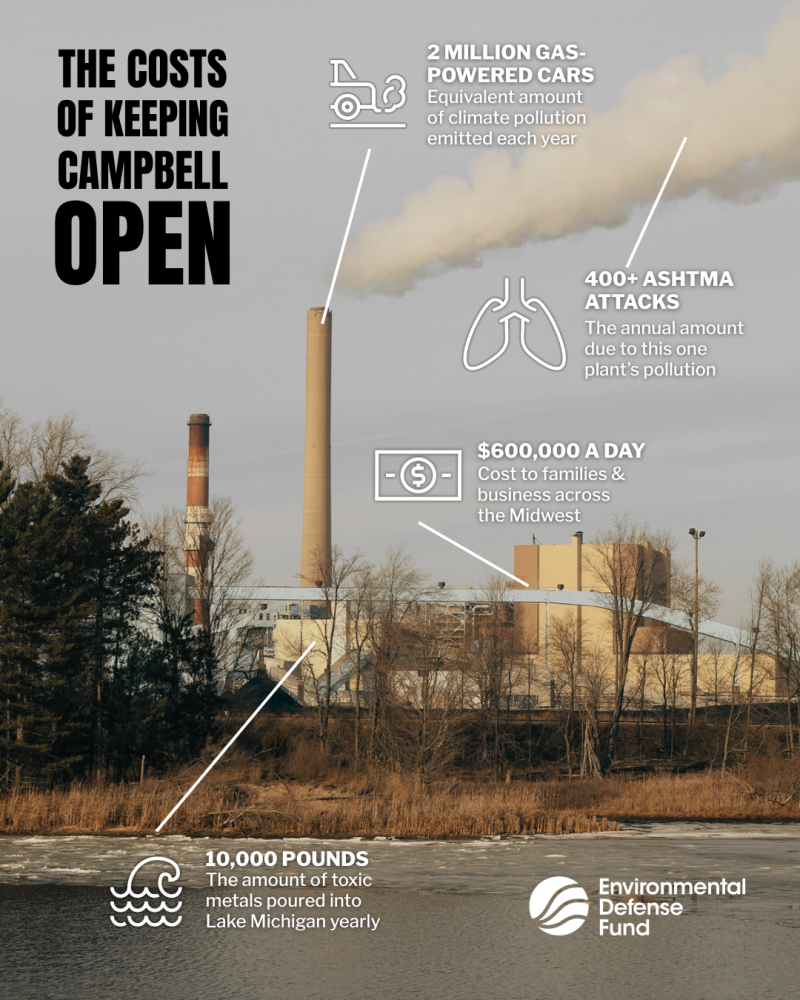
In total, the Trump administration has extended five coal plants in Michigan, Indiana, Colorado and Washington past their retirement dates, as well as a gas and oil plant in Pennsylvania. The two extended Indiana coal plants are within the same regional electricity market (known as MISO) as Campbell, so ratepayers in the Midwest will pay for their extensions as well.
“It’s been nearly a year since the Trump administration began illegally keeping coal plants open past retirement – and all it’s done is drive up costs. Families are paying higher bills and breathing more toxic pollution from aging, unreliable coal plants that aren’t even running or working half the time,” said Kelly.
Three states (Michigan, Minnesota and Illinois) and public interest groups have challenged the administration’s illegal Campbell coal plant order in the DC Circuit Court of Appeals, with oral arguments scheduled for May 15. The public interest groups argue that the Department of Energy is misusing its emergency powers as a tool for long-term grid planning, keeping coal plants open indefinitely, rather than addressing actual near-term electricity shortfalls.
Many of the extended coal plants have ended up failing or have not been needed to run at all, undermining the Department of Energy’s claim that they are “essential” to reliability. New financial filings just revealed that the extended Centralia coal plant in Washington state will cost ratepayers in the Pacific Northwest $20 million, even though it did not generate electricity during the supposed “emergency” period.
In other instances, these coal plants have failed: The J.H. Campbell plant itself partially failed last summer during soaring temperatures, one Indiana unit has been down since July 2025 and one unit of the Craig plant in Colorado was down in January of this year.
Coal plants break down more than any other type of electricity in the United States (according to the North American Reliability Corporation), and an independent report from Grid Strategies found that if the Trump administration issues more mandates to keep aging coal power plants online, it could cost U.S. electricity consumers as much as $6 billion per year.
With more than 3 million members, Environmental Defense Fund creates transformational solutions to the most serious environmental problems. To do so, EDF links science, economics, law, and innovative private-sector partnerships to turn solutions into action. edf.org
Related Expert

Director and Lead Counsel, U.S. Clean Energy
Latest press releases
-
Statement: Trump EPA proposes weakening health protections against pollution from new diesel buses and trucks
July 9, 2026 -
EDF appeal seeks court review of costly, unsupported Florida transmission project that ignored lower-cost alternatives
July 9, 2026 -
Groups file comments vigorously opposing EPA’s proposal to weaken life-saving protections against air pollution from cars
July 7, 2026 -
Groups challenge Department of Energy’s illegal Orlando area coal plant extension
July 7, 2026 -
Coming soon: a proposal to weaken protections against dangerous pollution from buses and trucks
July 6, 2026 -
Trump EPA stacks science panel with chemical industry insiders
July 2, 2026